
A few years ago, a digital marketing influencer’s day looked like this: brainstorm ideas for an hour, script for another hour, film, edit for half a day, then rewrite the same post for LinkedIn, Instagram and YouTube. Today, much of that grind happens in minutes.
At Mevora Digital, we work with content and campaigns every day, and the change is hard to miss. AI hasn’t replaced influencers. It has changed what they spend their time on. Here is what is really happening, what still needs a human, and what it means if you are a creator or a brand.
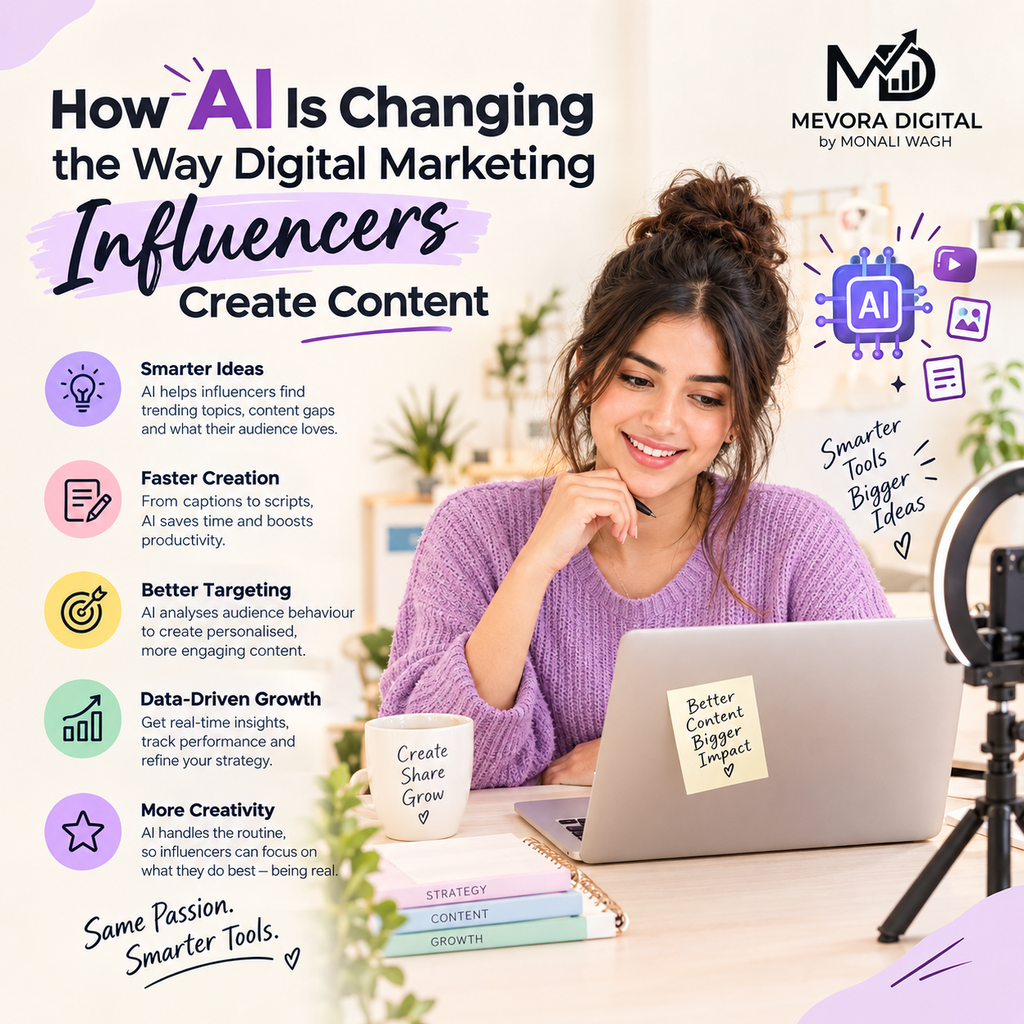
1. Idea Generation Is Faster, but Only for Those Who Ask Better Questions
Every influencer hits the “what do I post today?” wall. AI tools such as ChatGPT, Claude and Gemini can now suggest dozens of angles in seconds.
The catch is that a generic prompt gives generic ideas. “Give me post ideas about SEO” returns the same advice everyone else gets. The creators who win are those who feed AI their own context: their audience’s real questions, comments from past posts, and recent client problems. AI then works like a sharp intern, and the creator still makes the editorial call.
Practical tip: Paste your last 10 audience comments or DMs into an AI tool and ask, “What questions keep repeating?” That is your content calendar for the month.
2. Scripting and Drafting Have Become a Two-Step Process
Most creators now use AI for a first draft of captions, LinkedIn posts, video scripts and newsletters. The draft is rarely publishable. It is a starting structure.
What separates good creators from average ones is the second step: rewriting in their own voice, adding a real story, a real number from their own work, or a strong opinion. Audiences can spot flat, over-polished AI writing quickly, and they scroll past it.
[Add your own experience here: one line about how your team drafts content with AI and what you change before publishing. This is the “Experience” signal Google looks for.]
3. Video Editing Has Become Far More Accessible
This is where the biggest time savings are. Tools like CapCut, Descript, Opus Clip and Canva now offer:
- Automatic captions in multiple languages, including Hindi
- Clipping long videos into short reels
- Filler-word and silence removal
- Background noise cleanup
- Auto-resizing for Reels, Shorts and LinkedIn
A creator who once needed a full-time editor can now produce good short-form video alone. That lowers the entry barrier, which is great for newcomers but also means more competition for attention.
4. Repurposing One Idea Across Platforms
One webinar or podcast can now become a blog post, five short clips, a carousel, a newsletter and a thread. AI handles the reformatting, and the creator focuses on the core message.
For Indian creators, this matters most in regional language content. AI translation and dubbing tools help a creator reach Hindi, Marathi, Tamil or Bengali audiences without rebuilding everything. Quality still varies, so always have a native speaker review the output before it goes live.
5. Research and Analytics Are Smarter
AI helps creators see what is working. It can summarise which posts drive saves and shares, spot patterns in comments, and estimate the best posting times. Brands also use AI to screen influencers for fake followers and audience quality, which is a real concern in influencer marketing.
Still, dashboards show what happened. They can’t tell you why your audience trusts you. That understanding comes from people.
Where AI Still Falls Short
Being honest about limits builds trust, so here are the main ones:
- Accuracy: AI can state wrong facts confidently. Always fact-check statistics, tool features and platform rules.
- Originality: AI recombines what already exists. It has no lived experience.
- Authenticity: Influence runs on trust. If followers feel deceived, the damage is hard to undo.
- Cultural nuance: Humour, festivals, local context and sensitivity often need a human touch.
Transparency Matters More Than Ever
In India, influencers are expected to disclose paid partnerships clearly, and the ASCI (Advertising Standards Council of India) has guidelines on this. Similar honesty is a smart habit for AI use. You don’t need to label every caption, but never fake results, testimonials or personal claims with AI. Fully AI-generated faces or voices promoting a product without disclosure risk both legal trouble and audience trust. Check the latest ASCI and government rules before running campaigns.
What This Means for Brands
If you hire influencers, ask a few simple questions:
- How do you use AI in your content process?
- Who reviews and fact-checks the final content?
- Can you show examples of original, experience-based content, not just polished posts?
- How do you disclose sponsored content?
Choose creators who use AI to work faster and still show a clear point of view. Speed without substance is easy to find. Real expertise is not.
What This Means for Creators
- Use AI for the boring parts: transcription, resizing, first drafts, research.
- Keep the human parts yours: opinions, stories, case studies, results.
- Build a recognisable voice. When everyone has the same tools, your personality is your advantage.
- Show proof. Share real screenshots, results and lessons, with permission.
- Keep learning. Tools change every few months. Test them yourself before recommending them.
The Bottom Line
AI is not making digital marketing influencers obsolete. It is separating those who only produce content from those who bring real insight. The tools handle speed and scale, but trust, credibility and originality still come from people.
The winning approach for 2026 is simple: use AI to work smarter, then add what no tool can, your experience.
Frequently Asked Questions
Will AI replace digital marketing influencers?
Unlikely. AI can generate content, but audiences follow people they trust. Influence depends on credibility and personality, which AI can’t replicate.
Which AI tools do influencers use most?
Common choices include ChatGPT, Claude and Gemini for writing, Canva and CapCut for design and video, and Descript or Opus Clip for editing and repurposing. Tools change quickly, so test them before committing.
Is it okay to use AI-generated content on social media?
Yes, if you review it, fact-check it, and don’t mislead your audience. Follow platform rules and Indian advertising guidelines on disclosure.
How can small businesses benefit from this shift?
AI lowers content production costs, so even small brands can run consistent campaigns with micro-influencers on modest budgets.